 EN

Why Anchoring an Inflatable Floating Dock Is Different From a Rigid Dock
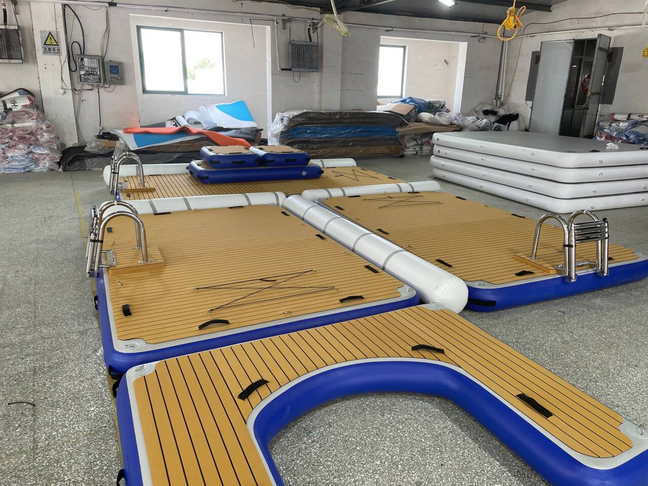
An inflatable floating dock is light on the trailer and heavy on the water once wind gets under the deck. That combination changes anchoring. A rigid dock has mass and displacement working together, and a couple of piles or a few hundred pounds of concrete often keep it in place. An inflatable floating dock rides higher, catches more wind, and moves with every wave instead of resisting it. The anchor system has to absorb dynamic loads without transferring them into a few fabric patches. It also has to tolerate tide and seasonal water level changes, because a short, tight line will either lift an anchor or tear a D-ring when the water drops. The goal is not to pin the dock rigidly. The goal is to let it ride with a controlled range of motion, so the floats and the hardware share the load instead of fighting each other.
Matching Anchor Type to Bottom Conditions and Fetch
Anchor choice starts with what is under the water and how much open water the wind can cross. A screw anchor bites well in sand and firm mud but spins out in loose silt. A mushroom anchor suits soft bottoms but needs a long scope and steady tension to set. Concrete blocks are simple and cheap, yet holding power depends almost entirely on weight and bottom friction, so a block that works in a sheltered cove can drag in a two-foot chop. Shore deadmen, trees, or rock pins work where the shoreline allows, but they limit how much the dock can swing. The table below reflects typical field trade-offs.
| Anchor type | Best bottom | Holding style | Installation effort | Adjustability | Wave exposure |
|---|---|---|---|---|---|
| Screw anchor | Sand, firm mud | Mechanical bite | Medium, diver or long pole | Good | Moderate |
| Mushroom anchor | Soft silt, mud | Suction and bury | Low | Fair | Low to moderate |
| Concrete block | Any, poor in rock | Weight and friction | High, barge or crane | Poor | Low |
| Shore deadman | Shoreline soil or rock | Buried or pinned | Medium | Limited by line | Good in sheltered fetch |
| Pile or post | Any, driven | Structural | High | Fixed | High |
The honest limitation is that no single anchor type covers every site. A mixed system, such as two screw anchors offshore and two shore lines, often gives better security than four identical anchors.
Setting the Mooring Geometry So the Dock Rides, Not Slaps
Four-point mooring is the baseline for a floating dock of any size, and the geometry matters more than the hardware. Lines should lead out at roughly 45-degree angles from the dock corners, so a gust from any direction loads at least two anchors. Scope, the ratio of line length to water depth, needs enough slack for the highest expected water level and enough tension to keep the dock from wandering. A 4:1 scope is a common starting point in sheltered water; exposed sites often need more. Elastic rode or a shock absorber in the line reduces snatch loads on the D-rings. A single bow line, the setup seen most often on rented docks, lets the platform yaw and slap, and every slap works the anchor point. Wind load on railings, umbrellas, and solid panels is easy to underestimate, and ASCE 7 wind load provisions give a reasonable way to estimate it rather than guessing.
Reinforcing Anchor Points on the Float Itself
The strongest anchor in the lake is useless if the D-ring patch peels off in the first blow. Anchor points on an inflatable dock should be wide webbing patches bonded to the float body, not small tabs stitched to a seam. Load should spread across a reinforced panel, and the line should never bear on a valve or a seam. A common field mistake is clipping a line directly to a handle or a valve cap. Those parts are not designed for mooring loads. A load spreader, such as a short strap around the float body connected to the D-ring, helps distribute tension. Inspect the patch edges and the thread line each season, because UV exposure and repeated flexing are the real enemies.
A Reservoir Dock That Kept Swinging Until the Geometry Changed
A rental operator on a wind-exposed reservoir installed a 24 by 10 foot inflatable floating dock for paddleboard launches. The first season used a single heavy mushroom anchor off the bow and two short shore lines. The dock swung through a wide arc, slapped against the shore at night, and wore the bow D-ring patch until it started to lift. The fix was not a bigger anchor. The crew switched to four-point mooring, two screw anchors offshore set at 45 degrees and two longer shore lines with elastic sections, and added a load spreader at each corner. The swinging stopped, the D-ring patches held, and the operator could adjust the dock position for changing water levels without a barge. That case shows the pattern: anchoring failures usually come from geometry and load paths, not from anchor size alone.
Inspection, Seasonal Adjustment, and Honest Limits
An inflatable floating dock needs a pre-season check that goes beyond a quick look. Check float pressure, because a soft float changes the load path and can let water over the deck edge. Check line chafe where it passes through hardware, and check the anchor set by tensioning each line and watching for drag. In ice country, pull the dock or plan for ice movement, because no fabric float wins against shifting ice. ASTM F2624 covers inflatable buoyancy products and gives a useful reference for labeling and construction, but site conditions still demand a margin. Higher Sports supplies commercial-grade inflatable flotation and water leisure products through a Laixi production base and a California warehouse, with batch-consistent quality control and replenishment support for operators who need to keep a season on schedule.
Table of Contents
- Why Anchoring an Inflatable Floating Dock Is Different From a Rigid Dock
- Matching Anchor Type to Bottom Conditions and Fetch
- Setting the Mooring Geometry So the Dock Rides, Not Slaps
- Reinforcing Anchor Points on the Float Itself
- A Reservoir Dock That Kept Swinging Until the Geometry Changed
- Inspection, Seasonal Adjustment, and Honest Limits