 EN

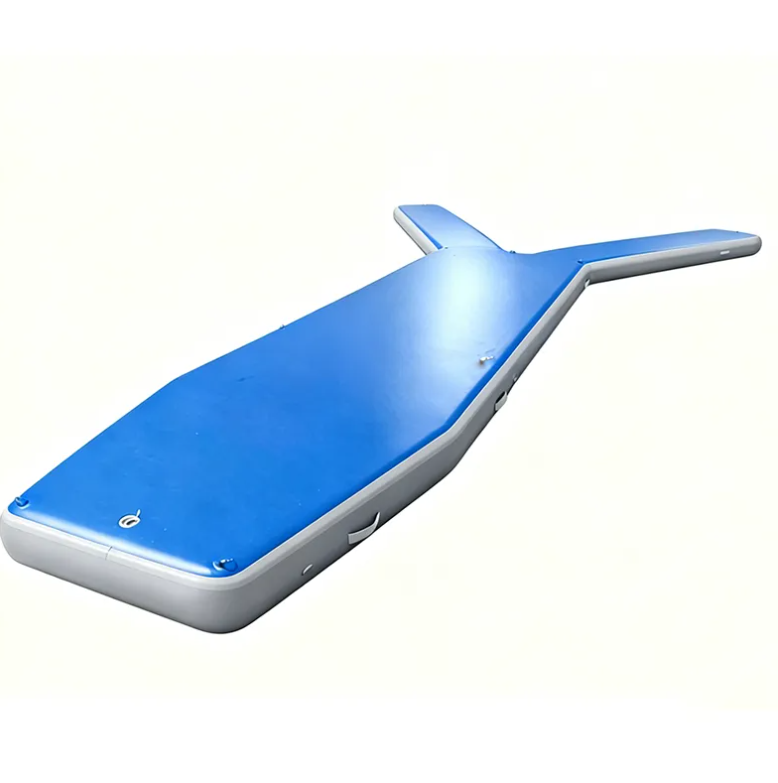
How Buoyancy and Physics Determine Inflatable Dock Floating Platform Stability
Archimedes’ Principle in Action: Why Displacement Matters More Than Air Volume
An inflatable dock floating platform stays afloat because the water it displaces weighs as much as the platform and its load—this is Archimedes’ principle. Many assume that more air inside the pontoons means greater buoyancy. In reality, buoyancy depends solely on the volume of water displaced, not internal air pressure or volume. A wide, flat hull displaces significantly more water per inch of submersion than a narrow, high-pressure tube—even with identical air volume. For example, a squared-off profile generates stronger upward force at shallow drafts by maximizing submerged cross-section. The air inside maintains structural integrity but contributes no lift directly. Therefore, designers prioritize submerged volume—achieved through broader footprints and controlled draft—over inflation metrics when optimizing for load-bearing stability.
Stability vs. Buoyancy: Why High Floatation Doesn’t Guarantee Low Tilt or Wobble
Buoyancy keeps the platform afloat; stability prevents tipping. A dock can float high yet feel dangerously tippy if its center of gravity is elevated or its beam too narrow. Buoyancy acts vertically; stability is rotational resistance—governed by how far the center of gravity shifts relative to the pontoons’ edge when weight moves laterally. If that shift exceeds the platform’s base width, capsizing risk rises sharply. Wide pontoons, a low deck height, and rigid frame integration collectively lower the center of gravity and increase the righting moment—the force restoring level orientation after tilt. External features like sponsons or fenders further extend the effective beam, enhancing resistance to roll. So while high flotation supports weight, only a balanced design combining displacement, low center of gravity, and broad stance ensures reliable upright performance under real-world, uneven loading.
Real-World Environmental Challenges for Inflatable Dock Floating Platforms
Even a well-engineered inflatable dock floating platform must withstand unpredictable natural forces. Wave action, wind pressure, and currents impose dynamic loads that challenge both static stability and mooring integrity.
Wave Action, Wind Load, and Currents: Quantifying Dynamic Instability Risks
Continuous wave action applies cyclic lateral forces that destabilize positioning—especially where significant wave heights exceed 0.5 meters, a common threshold in sheltered coastal zones. Wind gusts above 15 knots generate measurable sideways thrust and tilting moments, while currents of 1–2 knots exert drag on submerged surfaces, compounding misalignment. These forces degrade usability and dramatically increase anchor line stress: industry field tests from 2023 show mooring tension can double under moderate combined conditions. As a result, anchoring systems must be selected using local environmental data—not generic ratings—to ensure long-term reliability and safety.
Water Level Fluctuations and Shoreline Slope: Effects on Platform Alignment and Anchoring Efficiency
Tides, seasonal fluctuations, and storm-driven water-level changes directly impact platform alignment and anchoring effectiveness. A dock designed for a fixed freeboard range may tilt severely—or even ground—if water drops below minimum operating depth or rises above deck height. Shoreline slope compounds this: steep banks cause the platform to pivot around shallow-end anchors, creating hazardous gaps; gentle slopes improve contact but demand longer, more complex mooring lines. When daily water-level variation exceeds 30 cm—typical in many tidal basins—manual re-anchoring becomes routine. While automatic adjustment systems exist, they add cost and complexity. Designing for a 1.5-meter tidal range and accommodating a minimum 1:5 shoreline slope provides robustness across most recreational and light-commercial applications, preserving safe boarding angles and consistent tie-down geometry.
Design Features That Enhance Inflatable Dock Floating Platform Stability
Intentional engineering choices—not just material quality—define real-world stability. Three interdependent factors dominate performance: low center of gravity, wide footprint, and structural rigidity.
Low Center of Gravity, Wide Footprint, and Rigid Frame Integration
Strategically placing heaviest components—such as batteries, seating, or integrated storage—at the lowest possible point lowers the center of gravity, reducing rotational leverage during movement or wind loading. A wide footprint (often ≥8 ft × 6 ft) increases resistance to tipping from lateral forces, while a rigid aluminum or reinforced composite frame binds inflatable sections into a unified structure—eliminating localized flex and distributing dynamic loads evenly. This synergy allows users to move confidently near edges and enables gear placement without compromising equilibrium. Marine engineers validate such designs using metacenter height calculations, ensuring righting force consistently exceeds overturning potential under typical operational loads.
Non-Slip Decking, Weight Distribution Guidelines, and Modular Interlocking Systems
Non-slip decking—using textured marine-grade PVC or EVA foam—ensures secure footing in wet, salty, or algae-prone conditions, directly supporting user safety and confidence. Practical weight distribution guidance recommends central placement of heavy items (coolers, chairs, equipment) to maintain balance and avoid edge-loading that triggers instability. Modular interlocking systems—typically built with stainless steel or high-strength polymer connectors—enable scalable configurations: multiple platforms join seamlessly into larger arrays, spreading load over wider surface areas and improving overall system stability. Critically, modularity also supports maintenance—damaged sections replace easily without full-system replacement—extending service life and sustaining performance integrity.
FAQ
What is Archimedes' principle and how does it relate to inflatable dock platforms?
Archimedes' principle states that an object floats if the weight of water it displaces equals its own weight. For inflatable dock platforms, this principle means buoyancy depends on the volume of water displaced, not air pressure or internal air volume.
What features improve the stability of inflatable dock platforms?
Features like a low center of gravity, wide footprint, and rigid frame integration improve stability by reducing tipping and distributing forces evenly. Elements like sponsons and modular interlocking systems further enhance overall platform performance.
How do environmental factors affect inflatable dock stability?
Wave action, wind load, and currents impose dynamic forces that challenge stability and mooring. Tidal changes and shoreline slopes also affect alignment, making robust design and adaptable anchoring systems critical.
Can inflatable dock platforms handle uneven loading?
Yes, if designed properly. Wide pontoons, a rigid frame, and weight distribution guidelines help handle uneven loading while maintaining balance and stability.
Why is a modular system beneficial for inflatable dock platforms?
Modular systems allow multiple platforms to be joined seamlessly, spreading load across larger surfaces and facilitating maintenance by easily replacing damaged sections.
Table of Contents
- How Buoyancy and Physics Determine Inflatable Dock Floating Platform Stability
- Real-World Environmental Challenges for Inflatable Dock Floating Platforms
- Design Features That Enhance Inflatable Dock Floating Platform Stability
-
FAQ
- What is Archimedes' principle and how does it relate to inflatable dock platforms?
- What features improve the stability of inflatable dock platforms?
- How do environmental factors affect inflatable dock stability?
- Can inflatable dock platforms handle uneven loading?
- Why is a modular system beneficial for inflatable dock platforms?